|
 |
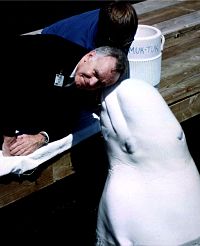
Charles R. Greene, Jr., Ph.D. (President and Principal Scientist)
has S.B. and S.M. degrees in Electrical Engineering from the
Massachusetts Institute of Technology and a Ph.D. in EE from
the University of California at Santa Barbara. He has
worked on underwater acoustics research and engineering
since 1959. Much of his earlier work was supported by the
U.S. Navy and involved underwater noise and acoustic
transmission loss experiments in the Arctic Ocean. Since
1980, he has worked with biologists studying the behavior of
whales and fish exposed to industrial noise. In 1983 he
founded Greeneridge Sciences to continue bioacoustics work.
In 1995 he completed a project for the U.S. Minerals
Management Service involving four field seasons at Barrow,
Alaska, studying the influence of industrial sounds on
migrating arctic whales in springtime. During that project
and also during an earlier (1980-84) project for MMS, he
provided and operated underwater sound sources that could be
used to test the responses of bowhead whales. For four
years beginning in 1996 he measured and described the pulsed
sounds of airgun arrays operated in the Beaufort Sea during
seismic surveys for hydrocarbon deposits. In support of
this effort, he has developed and used autonomous seafloor
recorders to store sound data for up to three weeks
continuously during seismic surveys and bowhead whale
migration. He is currently responsible for measuring the
industrial sounds in air and underwater associated with the
Northstar Development offshore near Prudhoe Bay and for
monitoring acoustically the locations of calling bowhead
whales passing Northstar during their fall migration. Dr.
Greene is the author of three chapters on physical acoustics
in the book Marine Mammals and Noise published by
Academic Press in 1995. He is a Fellow of the Acoustical
Society of America and serves on their Medals and Awards
Committee. He is a member of NOAA Fisheries' panel of
experts on noise standards for marine mammal exposure.
Download
curriculum vitae (PDF, 142 KB). |
 |
William C. Burgess, Ph.D. (Senior Research Engineer)
designed the first microprocessor-based acoustic recording
tag for marine wildlife in 1994. He created the first
commercial acoustic recording tags, the Acousonde™ and
its predecessor the Bioacoustic Probe™, leading the
industrial design, writing the software operating systems,
and designing all analog and digital electronics. These
instruments have been used by over sixteen marine research
and engineering organizations located in the United States
and abroad, not only for the study of protected species but
also for marine geophysics, underwater vehicle development,
officer training, and the monitoring of offshore oil
production facilities. Dr. Burgess’ technical
background includes geophysical remote sensing with
low-frequency radio, bioacoustics, audio-frequency signal
processing, and both hardware and software systems
architecture. His field experience includes over seven
months at remote sites in Antarctica, northern
Québec, and the Alaskan Arctic, and over four months
at sea on research vessels in Arctic, Antarctic, Atlantic,
Pacific, and Gulf of Mexico waters. He has acquired and
analyzed acoustic data from jet aircraft, rockets, missiles,
vessels, airguns, and pile drivers, and collaborated on the
analysis of acoustic and kinematic data recorded by his tags
on whales, seals, and sharks. Dr. Burgess received his
undergraduate and graduate degrees in Electrical Engineering
from Stanford University, and conducted ocean acoustic
research under postdoctoral scholarships at the Woods Hole
Oceanographic Institution (WHOI) and the Monterey Bay
Aquarium Research Institute (MBARI). He is a member of the
Acoustical Society of America (ASA), the IEEE Oceanic
Engineering Society, the Society for Marine Mammalogy, and
the American Geophysical Union, and chaired special sessions
on animal-bioacoustics instrumentation at ASA conferences in
2000 and 2005.
Download
curriculum vitae (PDF, 100 KB). |
 |
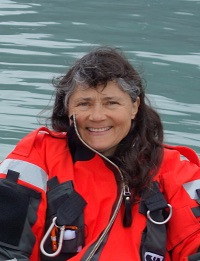
Susanna
B. Blackwell, Ph.D. (Senior Scientist) received a Licence
ès Sciences in Zoology from the University of Neuchâtel, Switzerland,
and her graduate degree in Biology from the University of
California Santa Cruz. She has held postdoctoral
positions at UCSC, the University of Stockholm and Hopkins
Marine Station of Stanford University, in all cases working
with large marine vertebrates northern and southern
elephant seals, bottlenose dolphins, Baltic grey seals,
Atlantic and Pacific bluefin tuna and albacore tuna.
She has been involved in the design and manufacture of
several types of seal data loggers, recording parameters
such as depth, temperature, heart rate, swim speed, activity
levels, bioluminescence and sound as a function of
time. Her field experience has brought her from rodent
trapping in alpine meadows to acoustic tracking of tuna in
the Pacific Ocean, and acoustic monitoring for bowhead
whales in the Alaskan Arctic. She joined Greeneridge
in May 2000 and has since collected and analyzed acoustic
data on man-made sounds in the Beaufort and Chukchi Seas, to
assess their range and impact on marine mammals. She
is a member of the Acoustical Society of America, the
Society for Marine Mammalogy and the Society for
Bioluminescence and Chemiluminescence.
Download
curriculum vitae (PDF, 49 KB). |
 |
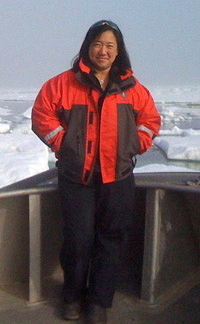
Katherine H. Kim, Ph.D. (Senior Research
Scientist) received her B.S. in physics from the
University of Illinois Urbana-Champaign, and M.S.
and Ph.D. in electrical engineering from the
University of California, the latter in a joint
program of the Scripps Institution of Oceanography
and the Department of Electrical Engineering. She
specialized in research problems in underwater
acoustics and signal processing as a postdoctoral
researcher at Scripps Institution of Oceangraphy and
then as a senior scientist at Heat, Light, &
Sound Research, La Jolla, California. Her background
includes work in adaptive and robust signal
processing methods for detection and localization of
ocean acoustic signals, covariance estimation and
source motion effects on adaptive array processing
and matched field processing, investigations into
acoustic pressure sensitivities to uncertainties in
3-D sound speed fields, ocean reverberation
modeling, underwater acoustic communications, and
ocean engineering. Dr. Kim has extensive sea-going
experience and holds advanced SCUBA and coastal
cruising certifications. Her current research areas
involve the passive acoustic monitoring of marine
mammals and the acoustic propagation associated with
their vocalizations, ranging from a variety of
dolphin in the Pacific Ocean to sperm whales in the
Gulf of Mexico to bowhead whales in the Arctic
Ocean. Since joining Greeneridge in June 2008, Dr.
Kim has collected and analyzed acoustic data in the
Alaskan Arctic to model and measure anthropogenic
and bowhead whale sounds. She is a member of the
Acoustical Society of America and the IEEE. Download curriculum vitae
(PDF, 88 KB).
|
 |
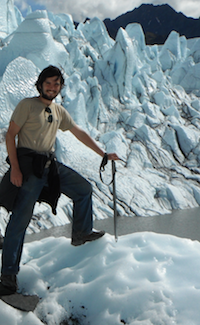
John Brandon, Ph.D. (Marine Stock Assessment Scientist)
provides modeling and statistical support to personnel
within the LGL Group and directly to clients. He has worked on
developing mark-recapture abundance estimates from
photo-identification data, including for the endangered Cook
Inlet beluga whale and the Bering-Chukchi-Beaufort Seas
(BCB) stock of bowhead whales. His field assignments have
included vessel-based and aerial surveys for marine mammals
and seabirds. John's experience as a fisheries scientist
began with the Southwest Fisheries Science Center of the
U.S. National Marine Fisheries Service in 1998. There he
assisted with research on dolphin populations that have been
affected by the tuna fisheries in the eastern tropical
Pacific. In 2003, he started graduate studies at the
University of Washington, School of Aquatic and Fishery
Sciences under the tutelage of Prof. André Punt. His
doctoral studies focused on quantifying uncertainty and
incorporating environmental stochasticity in Bayesian stock
assessments of marine mammals. John has presented much of
this work as an Invited Participant to the Scientific
Committee of the International Whaling Commission, in the
context of ensuring the sustainability of aboriginal whaling
catch quotas for BCB bowhead and eastern North Pacific gray
whales. In his dissertation, John developed methods for
incorporating environmental data into population dynamics
models and applied those methods to test the robustness of
management strategies given a range of forecasts of future
environmental conditions.
John is proficient in several programming languages,
including: Fortran, AD Model Builder, Visual Basic and
R/S-Plus. Additionally, he has practice with WinBUGS and
Stock Synthesis software packages. John is experienced with
likelihood and Bayesian approaches, and has applied
model-selection and averaging techniques as alternatives to
standard hypothesis testing.
In addition to his work on modeling and assessments, John
has served as a marine species observer on numerous aerial
and ship-based research surveys including the Yangtze River
in China, the South China Sea, the U.S. Atlantic and Pacific
coasts, the eastern Tropical Pacific, the Aleutian Islands
in Alaska, and the Arctic Ocean.
|
|